

Key Takeaways
- Xiaohongshu (RedNote) has become a primary search and research platform for Chinese financial consumers.
- With 350 million monthly active users – 50% born after 1995, 72% female, the platform now drives substantial cross-border banking demand, particularly toward Hong Kong.
- Financial brands win by combining KOL seeding, paid amplification and search interception, then embedding products into everyday life scenarios rather than advertising them directly.
When marketers think of Xiaohongshu, fashion, travel and beauty usually come to mind first. That picture is out of date.
According to XiaoHongShu’s Overseas Financial Industry Ecosystem report (小红书境外金融行業生态), published August 2026, the platform has become a search engine and community for financial literacy, wealth management and cross-border banking. For overseas financial institutions, especially those based in Hong Kong, XiaoHongShu is no longer an experimental channel. It is a primary route to customer acquisition.
Who uses Xiaohongshu for financial content in 2026?
The stereotype of the older, conservative financial investor does not describe this audience. The report shows that XiaoHongShu’s user base is young, urban, female-skewed and wealthier than most people assume.
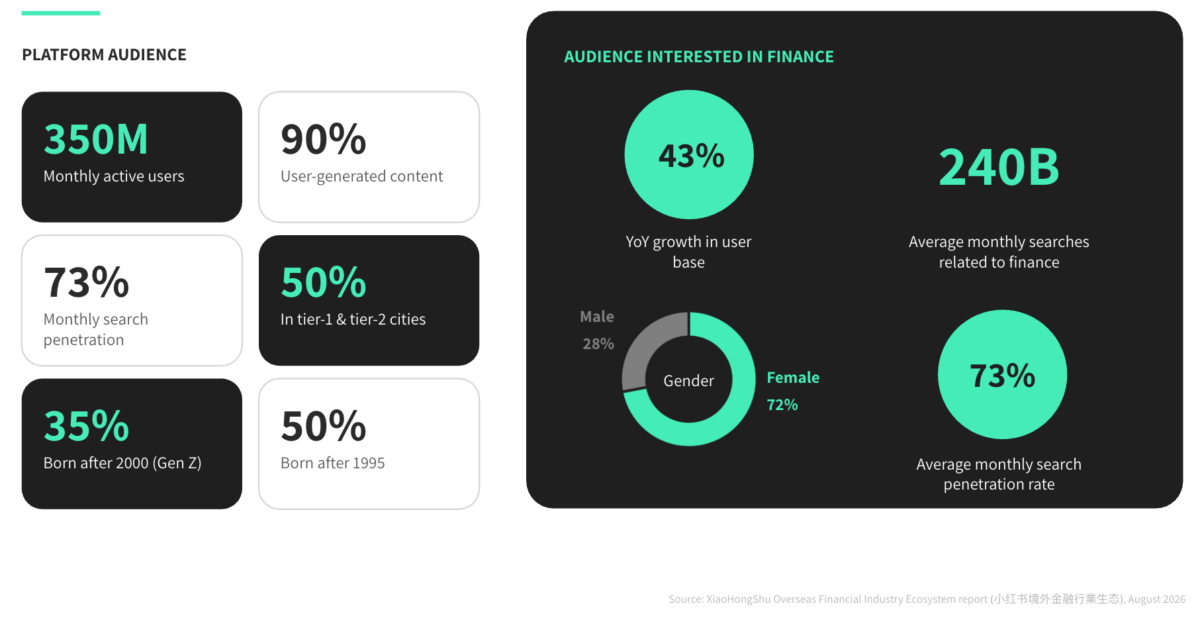
Platform Audience | ||
| Figure | Metric | What it means |
| 350 million | Monthly active users | XiaoHongShu has reached the scale of a major mainstream platform, giving financial brands access to a broad consumer audience. |
| 73% | Monthly search penetration | Nearly three in four users search on the platform each month, which means Xiaohongshu functions as a search engine, not only a feed. Financial brands can meet users at the moment of active research. |
| 50% | Tier-1 and tier-2 city residents | The audience is heavily concentrated in China’s more developed urban markets, where financial products, wealth management and lifestyle spending are highly relevant. |
| 35% | Born after 2000 | Gen Z represents a significant share of the platform, creating an opportunity to engage younger audiences earlier in their financial journeys. |
| 50% | Born after 1995 | Half of the user base belongs to younger generations, challenging the assumption that financial content is primarily consumed by older investors. |
Audience interested in Finance on XiaoHongShu | ||
| Figure | Metric | What it means |
| 43% | Year-on-Year growth in user base | Interest in finance has grown significantly compared with 2025 on XiaoHongShu. |
| 72% | Female users | Women are the majority of those who are interested in finance on XiaoHongShu, making the platform particularly relevant for brands looking to broaden conversations around wealth, financial planning and investment beyond traditional male-led narratives. |
| 240 billion | Monthly searches related to finance | The sheer volume of searches signals strong and recurring demand for financial information on the platform. |
| 73% | Finance-related search penetration | Financial topics are already part of the platform’s search behaviour, suggesting that users are actively turning to XiaoHongShu for information rather than simply consuming passive entertainment content. |
This makes XiaoHongShu more than a lifestyle platform. It is increasingly a discovery and research channel, where younger consumers and affluent audiences actively seek information that can shape financial decisions.
The trend is also visible in Hong Kong. Our February 2026 survey of 549 Hong Kongers found 62% XiaoHongShu penetration, rising to 90% among Gen Z (download the report here). For financial brands, this points to an opportunity to build relevance where younger audiences are already discovering, researching and discussing their financial ambitions.
Why do financial users prefer searching on Xiaohongshu?
The numbers explain the scale of the audience, but not why they choose to search on XiaoHongShu. The platform is not competing with financial media on expertise. It competes on three things they do not provide:
| Driver | What users get | What it means for brands |
| Authentic trust | Genuine peer sharing | Content that reads like a bank loses immediately |
| Woven into daily life | Finance appears inside lifestyle content | Products arrive through a scenario, not a hard-sell |
| Peer validation | Community consensus speeds decisions | Comments and saves are conversion signals |
Why is Hong Kong the biggest market for overseas financial demand on Xiaohongshu?
While regions like Macau and Singapore are experiencing growth, Hong Kong remains the undisputed leader for overseas financial demand on XiaoHongShu. Hong Kong benefits from the highest search volumes and a highly mature user mindset.
What exactly are Mainland users looking for when they look at Hong Kong?
| Demand category | Share of searches | Typical query |
| Account openings (bank and credit card) | 48% | “How to open a Hong Kong bank account” |
| Investment products | 20% | “Hong Kong wealth management for mainlanders” |
| Insurance | 19% | “Hong Kong insurance vs mainland insurance” |
On top of the search queries above, financial demand is highly seasonal and strongly correlated with travel. Spikes in search queries mirror major travel periods, as tourists weave tasks like opening a bank account into their holiday itineraries.
For a bank, this is close to ideal demand: specific, high-intent and tied to a calendar you can plan against. However, the difficulty is not finding the audience – it is staying visible long enough to meet them.
What is the KFS strategy on Xiaohongshu?
Organic content on XiaoHongShu peaks within 48 hours and fades after 7 days. The KFS framework: KOLs, Feeds and Search, exists to extend that window:
- KOLs generate relatable, high-quality “seeding” content.
- Feeds (Paid Ads) are used strategically to amplify top-performing posts, extending their lifecycle up to 30 days and pushing them to highly targeted demographic segments.
- Search captures the downstream intent. Brands are utilising “Brand Zones” to intercept active searches, ensuring that when a user searches for “Hong Kong Insurance,” they are greeted with an official, trustworthy brand presence.
How are banks linking online campaigns on XiaoHongShu to offline footfall?
KFS solves visibility online. The strongest campaigns of 2026 went further and gave people a reason to turn up in person.
Two Hong Kong campaigns in 2026 translated this well: partnering with a cultural landmark or IP and turning the physical experience into content. The location takes centre stage, while the bank plays a supporting role – creating a reason for audiences to visit, engage and share the experience.
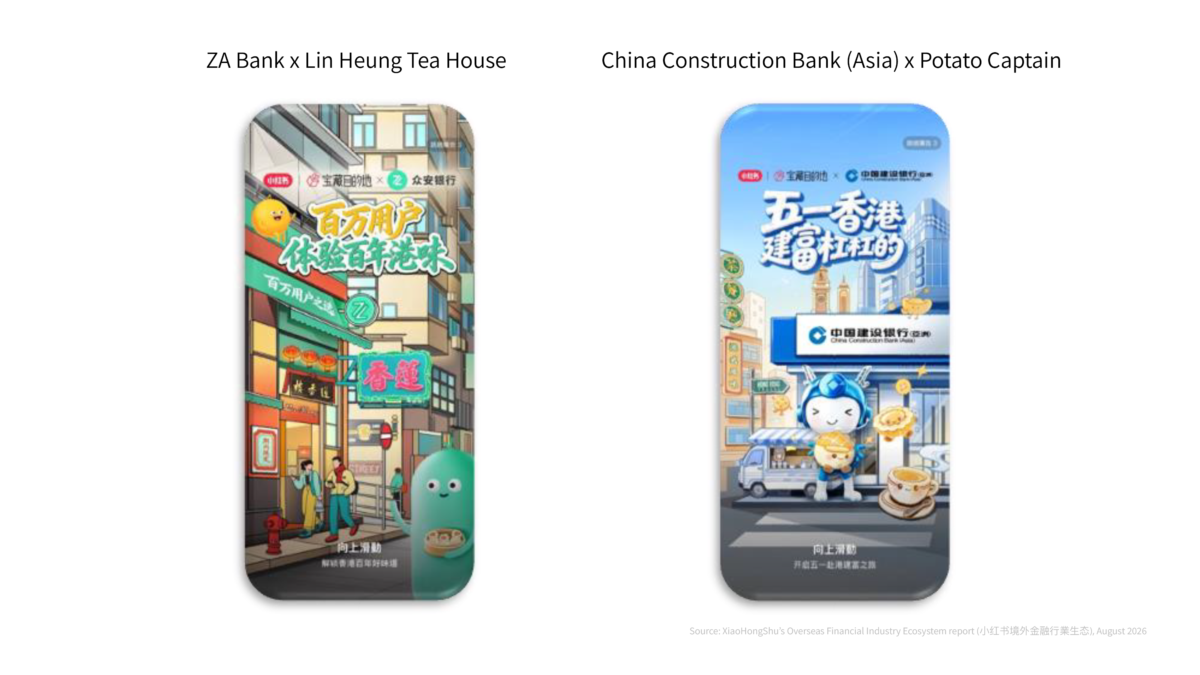
- ZA Bank x Lin Heung Tea House – Hong Kong’s first digital bank collaborated with the historic Lin Heung Tea House, a century-old Cantonese teahouse in Hong Kong that preserves old-school yum cha (tea and dim sum) traditions, creating an offline check-in craze that merged century-old Hong Kong nostalgia with modern digital banking.
- China Construction Bank (Asia) – the bank launched a massive May Day, also known as Labour Day campaign utilising “Potato Captain” (a popular IP mascot) and branded check-in spots at key locations like the Central Pier and SOGO – which lead to a 10x increase in new account openings during the holiday, with 70% driven by cross-border tourists.
How should financial brands approach content on Xiaohongshu?
What both campaigns share is a refusal to make the bank the subject. That instinct now runs through the platform.
In 2026, the biggest shift is from aggressive performance marketing to a “long-term trust narrative”. XiaoHongShu users reject overt advertising. They respond to emotional value and what the platform terms “lifestyle proposals.”
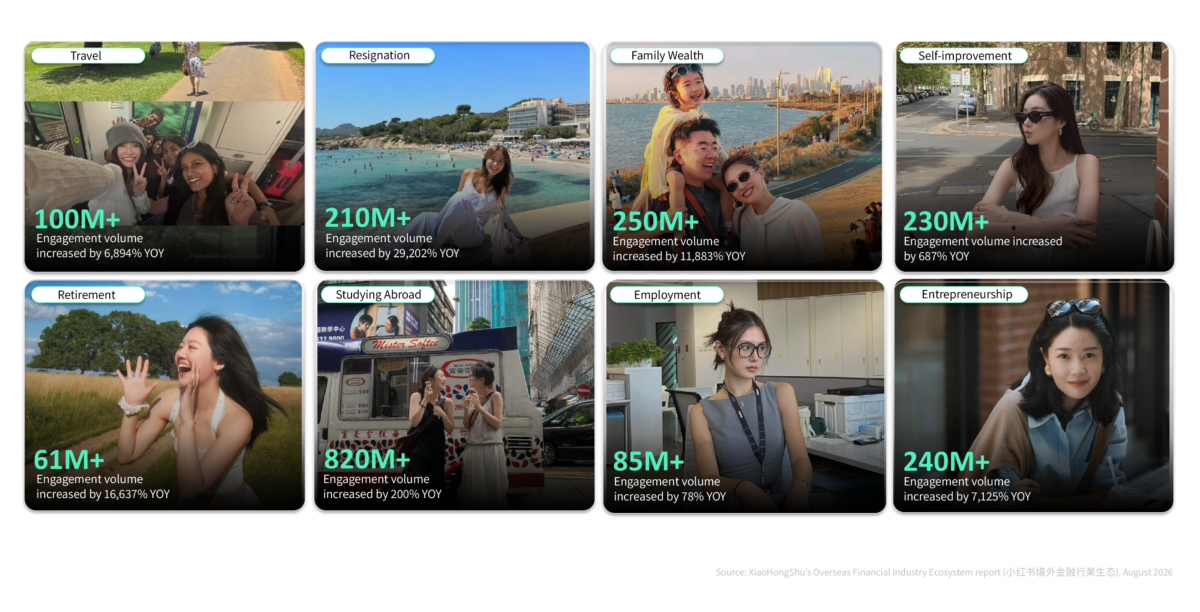
There are eight life scenarios that financial brands have successfully embedded products into:
- Travel
- Resignation
- Family wealth
- Self-improvement
- Retirement
- Studying abroad
- Employment
- Entrepreneurship
This means the content is never about the product. Instead of promoting a savings account, a brand publishes “a three-hour guide to organising your finances” or “how to fund a family outdoor adventure.” The financial product appears as the mechanism, not the headline.
Furthermore, banks are humanising their presence by utilising official, approachable mascot, China Merchants Bank, for example, uses Xiao Zhao Mi (小招咪) as a friendly brand persona to foster an ongoing dialogue with its audience, making the institution feel more relatable and approachable.
Looking Ahead
For overseas financial institutions, Xiaohongshu remains a relatively open field. The institutions that will win are those prepared to trade formal, product-led financial marketing for empathetic, scenario-driven content. That is a harder change for a bank to make than a budget increase, which is exactly why the opportunity persists.
Read more about top finfluencers in the region: